

STRUCTURE & ORGANISATION
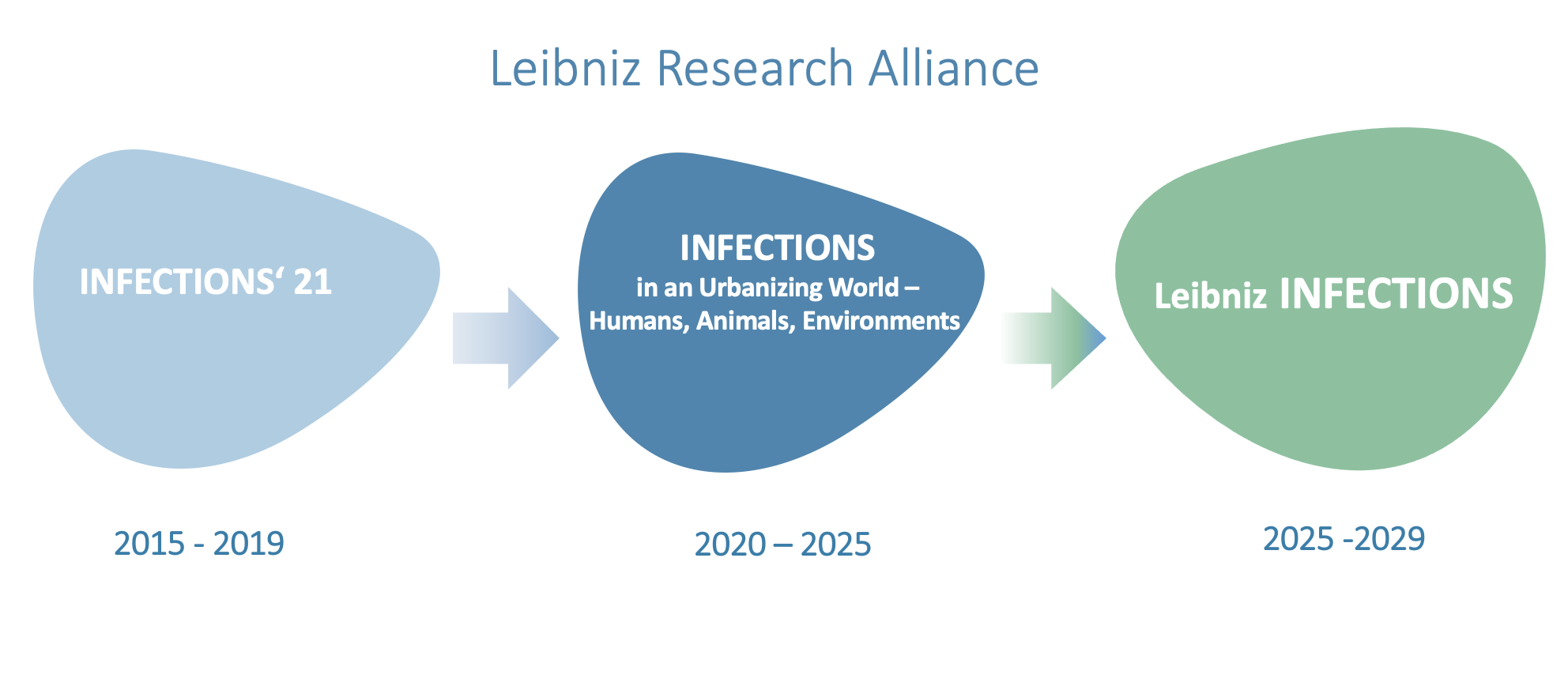
The Leibniz Research Alliance “INFECTIONS '21” was established in 2015 to address key questions in the field of infection research. To this end, a multidisciplinary consortium of Leibniz institutes and external partners was formed. In 2019, the alliance was renamed “INFECTIONS in an Urbanizing World – Humans, Animals, Environments.” This new name emphasizes the focus on a highly relevant topic in infection research: antimicrobial resistance (AMR). Since 2025, this interdisciplinary research alliance has continued under the name “Leibniz INFECTIONS.” The focus remains on antimicrobial resistance. 16 Leibniz Institutes and other scientific partners are involved.
The organizational structure comprises the Executive Committee, which has four members, and the Steering Committee, which has representatives from all Leibniz partner institutes. The Scientific Advisory Board (SAB) is an independent council. The SAB advises the consortium on new scientific developments and research approaches. The Executive Committee is responsible for the timely implementation of decisions. The Steering Committee and Scientific Advisory Board meet twice a year at the General Assembly, while the Executive Committee meets as required.

Section B - Economics, Social Sciences, Spatial Research
- Dr. Michael Stolpe - Kiel Institute for the World Economy (IfW)
- Prof. Dr. Renate Hartwig / Prof. Dr. Hendrik Schmitz - RWI – Leibniz Institute for Economic Research
- Prof. Dr. Marc Wolfram / Prof. Dr. Jochen Schanze - Leibniz Institute of Ecological Urban and Regional Development (IÖR)
Section C - Life Sciences
- Dr. Jan Priebe / Dr. Denise Dekker - Bernhard Nocht Institute for Tropical Medicine (BNITM), Hamburg
- Prof. Dr. Stefan Pöhlmann - German Primate Center, Leibniz Institute for Primate Research (DPZ), Göttingen
- Prof. Dr. Ulrich Nübel - Leibniz-Institute DSMZ–German Collection of Microorganisms and Cell Cultures, Braunschweig
- Dr. Daniel Roderer - Leibniz-Forschungsinstitut für Molekulare Pharmakologie (FMP), Berlin
- Prof. Dr. Ulrich E. Schaible / Prof. Dr. Thomas Gutsmann - Research Center Borstel - Leibniz Lung Center (FZB), Borstel
- Prof. Dr. Bernhard Hube / Prof. Dr. Ilse D. Jacobsen - Leibniz Institute for Natural Product Research and Infection Biology - Hans Knöll Institute (HKI), Jena
- Prof. Dr. Stephanie Pfänder / Dr. Adam Pietro Scaturro - Leibniz Institute for Virology (LIV), Hamburg
- Prof. Dr. Alex Greenwood / Dr. Kristin Mühldorfer - Leibniz Institute for Zoo and Wildlife Research (IZW), Berlin
Section D - Mathematics, Natural Sciences, Engineering
- Prof. Dr. Jürgen Popp / Dr. Jens Hellwage / Dr. Anja Silge - Leibniz Institute of Photonic Technology (IPHT), Jena
- Prof. Dr. Matthias Gunzer - Leibniz-Institut für Analytische Wissenschaften – ISAS – e.V. (ISAS)
Section E - Environmental Sciences
- Prof. Dr. Thomas Amon / Dr. Tina Kabelitz - Leibniz Institute for Agricultural Engineering (ATB), Potsdam
- Prof. Dr. Hans-Peter Grossart / Prof. Dr. Michael Monaghan - Leibniz Institute of Freshwater Ecology and Inland Fisheries (IGB), Berlin
- Dr. Doreen Werner / N.N. - Leibniz Centre for Agricultural Landscape Research (ZALF), Müncheberg
Section B - Economics, Social Sciences, Spatial Research
Prof. Dr. Renate Hartwig
RWI - Leibniz-Institut für Wirtschaftsforschung, Essen
Section C - Life Sciences
Prof. Dr. Thomas Gutsmann
FZB - Research Center Borstel, Leibniz Lung Center (FZB), Borstel
Section D - Mathematics, Natural Sciences, Engineering
Prof. Dr. Jürgen Popp
Leibniz Institute of Photonic Technology (IPHT), Jena
Section E - Environmental Sciences
Prof. Dr. Hans-Peter Grossart
Leibniz Institute of Freshwater Ecology and Inland Fisheries (IGB)
Section B - Economics, Social Sciences, Spatial Research
Prof. Dr. Dr. Till Bärninghausen
Heidelberg Institute for Global Health
Faculty of Medicine at Heidelberg University
Section C - Life Sciences
Prof. Dr. Jan Buer
Institute for Medical Microbiology
Universitätsklinikum Essen
Section D - Mathematics, Natural Sciences, Engineering
Prof. Dr. Janina Kneipp
Department of Chemistry
Humboldt-Universität zu Berlin
Section E - Environmental Sciences
Prof. Dr. Thomas Berendonk
Institute of Hydrobiology
Technische Universität Dresden
Section C - Life Sciences / Section E- Environmental Sciences
Prof. Dr. Christina Hölzel
Institute for Animal Breeding and Husbandry
Kiel University- Christian-Albrechts-Universität zu Kiel
Section C - Life Sciences
Prof. Dr. Michaela Lackner
Institute of hygiene and medical microbiology
Medical University Innsbruck