

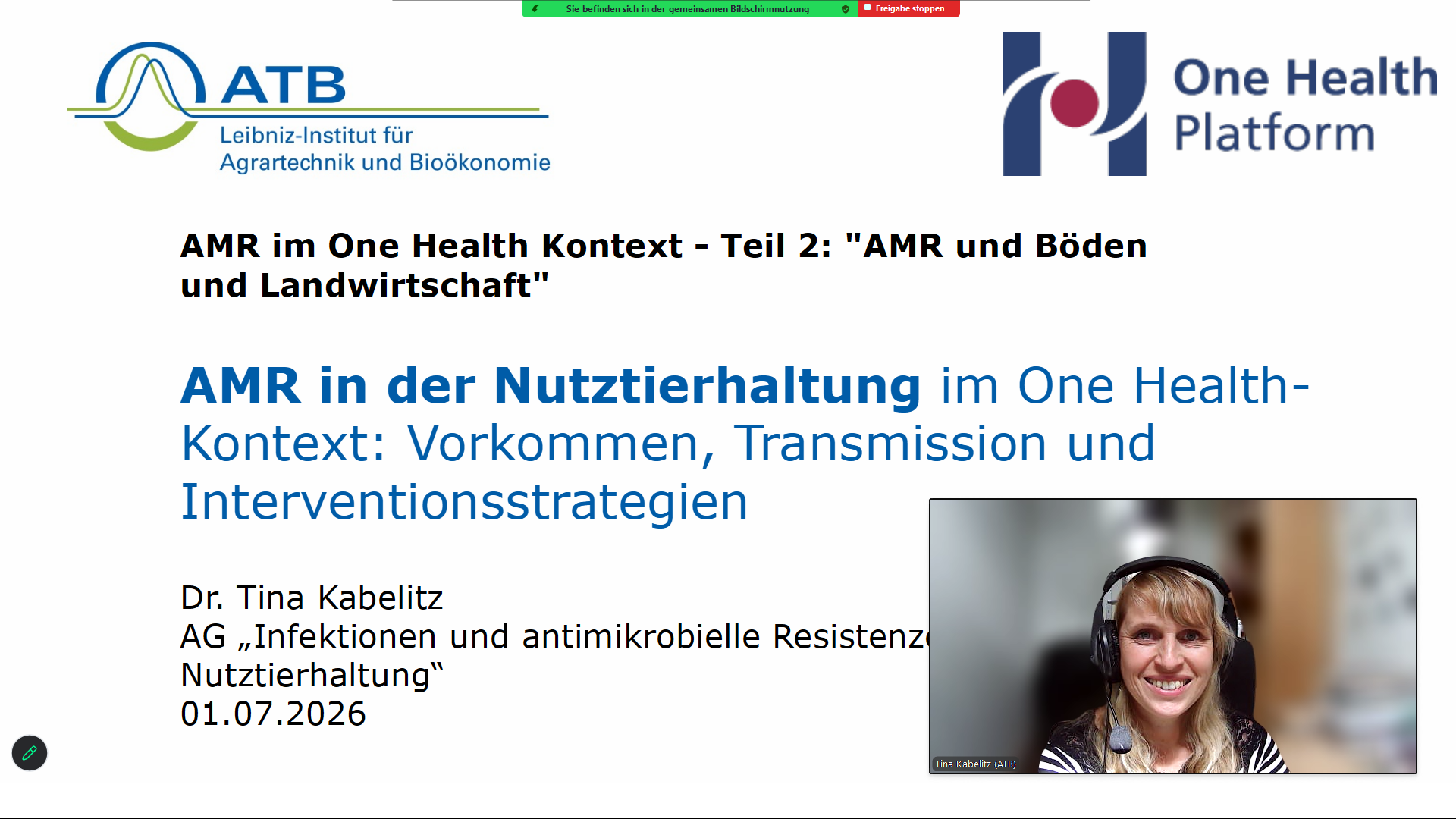
During an online lecture series organized by the “One Health Platform,” experts discussed the role of livestock farming and soil in the spread of antimicrobial-resistant microorganisms. INFECTIONS researcher Dr. Tina Kabelitz from the Leibniz Institute for Agricultural Engineering and Bioeconomy (ATB) presented research projects from the Leibniz Research Alliance.
The global spread of antimicrobial resistance (AMR) is among the greatest health threats worldwide. As part of the virtual lecture series “AMR in the One Health Context” on July 1, 2026, researchers highlighted how closely intertwined the interactions between livestock farming, soils, and ecosystems are in the agricultural sector. The focus was on the realization that the environment is not a passive recipient but rather functions as a reservoir and evolutionary laboratory for resistance.
Transmission Routes in Livestock Farming
Dr. Tina Kabelitz from the Leibniz Institute for Agricultural Engineering and Bioeconomy (ATB) represented the Research Alliance Leibniz INFECTIONS. In her presentation, she provided information on the prevalence and transmission routes of AMR in livestock farming. Since an estimated three-quarters of all antibiotics used worldwide are consumed in veterinary medicine, agriculture plays a key role in resistance dynamics. “Our research makes it clear that reducing AMR is only possible through One Health measures.”
Kabelitz demonstrated the importance of research using pig fattening as an example: In piglets newly placed in a pen, an increase in resistant E. coli bacteria is often observed, which cannot be explained solely by the current use of antibiotics in the pen. Stress factors such as transport, separation from the mother, and changes in feed contribute to this trend. The researcher also highlighted the role of environmental factors in the spread of these bacteria within the barns. High levels of resistant bacteria were detected in both barn dust and flies, which supports the role of insects as vectors and the airborne spread via aerosols. Surprisingly, one study found that expanding hygiene measures—including optimized disinfection and insect control—does not necessarily lead to a significant reduction in resistance. Clearly, hygiene alone is not sufficient to reduce resistance in animal husbandry, as resistance is a highly complex problem.
Solutions from the Barn to Manure Management
According to Kabelitz, effective intervention strategies are integrated measures that focus on animal welfare and prevention. These include, among other things, outdoor climate-controlled barns, where animals have more space and can better engage in their natural behaviors. The animals are then healthier and require fewer antibiotics overall. Disease prevention is also important. For example, it has been shown that an AI-supported early-warning system can detect mastitis in dairy cows earlier, making it easier to treat with antibiotics. Another key area is manure management: The targeted treatment of chicken manure through composting or anaerobic digestion—controlled by parameters such as moisture and temperature—offers promising approaches for effectively reducing the survival rate of resistant pathogens before the manure is spread on fields.
Manure and Environmental Stressors Alter the Soil Resistome
The other two presentations addressed the situation of soils in detail. Prof. Dr. Anja Worrich, from the Brandenburg University of Technology Cottbus-Senftenberg, explained how the application of manure influences the plant-associated microbiome and how climate change controls the fate of resistance genes in the soil. Prof. Dr. Michael Schloter of the Technical University of Munich also confirmed that agricultural soils exhibit the highest diversity of clinically relevant high-risk resistance genes compared to forest or urban soils. However, urban soils are also contaminated, particularly as a result of reduced biodiversity. He also pointed out the effect of co-selection: even pollutants such as heavy metals or pesticides can induce multidrug resistance to antibiotics via nonspecific defense mechanisms in bacteria.
Further Information (in German):