

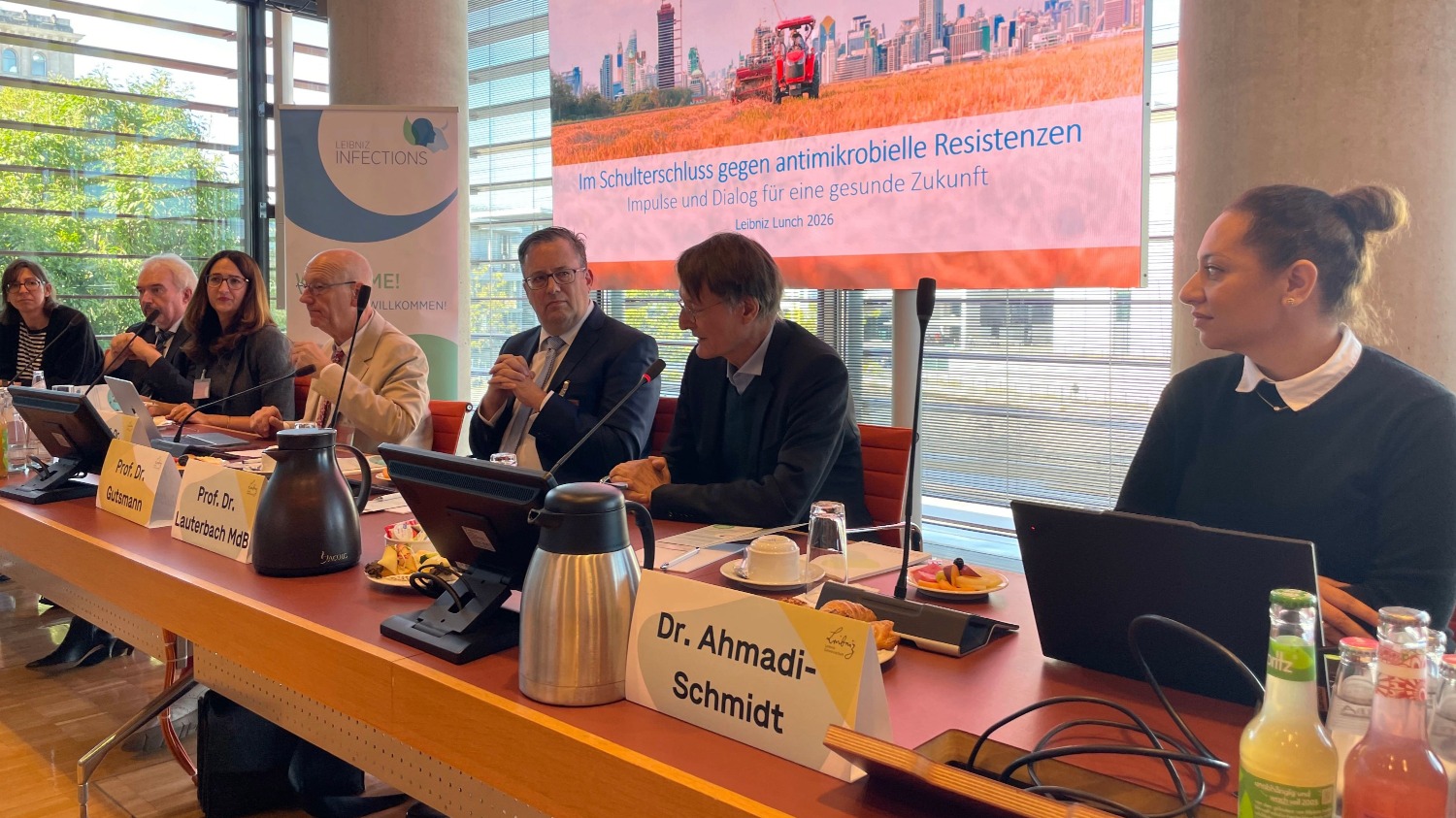
Antimicrobial resistance is a global challenge that effects human health, animal health and the environment. At the Leibniz-Lunch, scientists from Leibniz INFECTIONS discussed the scientific basis of antimicrobial resistance (AMR) and potential areas of action with members of the German Bundestag.
New antimicrobial resistances are developing faster than effective countermeasures can be devised. Prof. Dr Karl Lauterbach, Chair of the Committee on Research, Technology, Space and Technology Assessment, drew attention to this growing challenge on 23 September 2026 at the start of the Leibniz Lunch in the German Bundestag. The event, held under the title ‚Standing together against antimicrobial resistance. Impulses and dialogue for a healthy future‘, brought together scientific expertise and political perspectives. Representatives of the research alliance Leibniz INFECTIONS, invited by the Leibniz Association and Prof. Lauterbach, provided insights into various facets of the AMR challenge. Around 15 members of the German Bundestag from the SPD, CDU/CSU, Alliance 90/The Greens and the Alternative for Germany (AfD) party, as well as their staff, attended the event to learn more and engage in discussion. Key topics included the need for cross-ministerial and cross-sectoral approaches to AMR, the conditions for responsible antibiotic use, and research and innovation to ensure the reliable availability of effective antibiotics. The discussion also raised questions about suitable economic frameworks and possible new funding and innovation instruments.
The threat posed by resistant pathogens is very real. According to the latest estimates from the WHO, antimicrobial resistance in bacteria was associated with over 4.7 million deaths worldwide in 2021. For 2019, a global modelling study estimated that 1.27 million deaths were directly attributable to bacterial AMR, with a further 4.95 million deaths being associated with it. O’Neill‘s (2014) projection suggests that this figure could rise to 10 million if no action is taken, as emphasised by Prof. Dr. Ulrich E. Schaible of Research Center Borstel, Leibniz Lung Center.
One Health: Understanding resistance across sectors
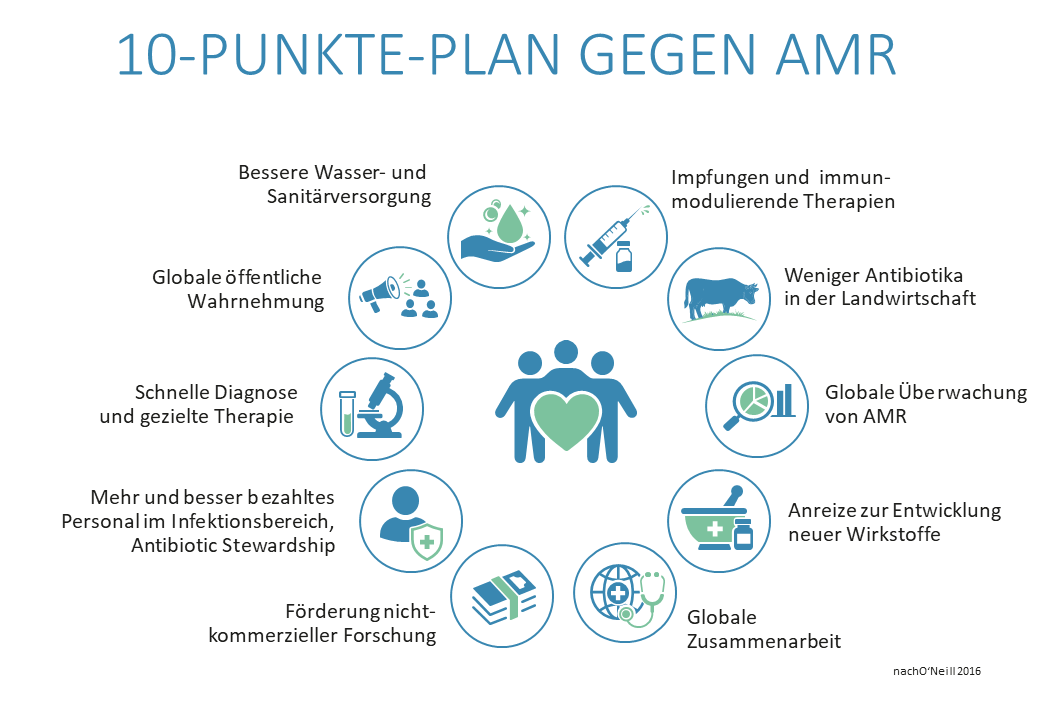
AMR cannot be addressed within a single healthcare system or field of research alone. Resistant microorganisms and resistance genes can move between humans, animals and the environment. At the same time, antibiotic use, agricultural practices, infection prevention and control measures, and social and economic conditions, influence the emergence and spread of resistance. International policymakers have repeatedly addressed these interconnections. For example, in 2017 the G20 committed to advancing the implementation of national action plans based on a One Health approach. These plans promote responsible antibiotic use across all sectors, strengthen research and development, and examine practical options for market incentives. ‘This issue was also put back on the agenda at the G20 Summit in Indonesia in 2022 and at the summit in Brazil in 2024,‘ said Schaible. He also pointed out that fungi, as a ‘neglected group of pathogens‘, require more attention. Resistance to available antifungal drugs is already increasing, partly because the same active substances are used in agriculture to combat fungal diseases in crops. Schaible added: ‚I believe that it is not only resistant bacteria, but also resistant fungi that are bringing a wave towards us. We still do not really know how to deal with it.‘ As a basis for discussion, the infection biologist and tuberculosis expert presented a ten-point plan for tackling antimicrobial resistance.
Global spread and surveillance of resistance
Dr Denise Dekker of the Bernhard Nocht Institute for Tropical Medicine in Hamburg addressed the global dimension of the antibiotic resistance crisis, because resistance knows no borders. ‘Through the transport of goods and increased mobility in general, pathogens and resistance genes are spreading. In every country, there are numerous interfaces for the exchange of pathogens and resistance genes between humans, animals and the environment,‘ the microbiologist explained. Her research focuses particularly on countries south of the Sahara, and she emphasised that the conditions for the emergence, spread and control of AMR vary internationally. Global molecular surveillance is essential to identify which resistance mechanisms are circulating worldwide at an early stage. 'In recent years, the German Federal Ministry of Health has funded the development of integrated genomic, or molecular, surveillance. It was an excellent programme because it enabled us to examine the genome and identify which multidrug-resistant bacteria were present and where new virus variants were emerging. This made it possible to better understand outbreaks and respond appropriately with infection-control measures, for example in hospitals,” she explained. She therefore expressed regret that the programme ended in 2025.
Prof. Dr Stefan Schwarz of Freie Universität Berlin presented an overview of the current situation in livestock farming. Considerable progress has been made in this area in recent decades. For instance, the use of antibiotics as growth promoters has been prohibited in Europe since 2006. In Germany, antibiotic use has also declined significantly. 'Since 2011, the quantity of antibiotics sold for use in animals has fallen by more than two thirds. However, we have now reached a low point and there is no longer any scope for a further substantial reduction,‘ said the Director of the Institute for Microbiology and Animal Diseases. He also emphasised the need for molecular surveillance. Even when certain antibiotics are no longer used, resistance to them can persist. 'This has to do with co-selection and persistence,' he explained.
Recognising antibiotics as strategic health infrastructure
The economic perspective is also relevant. Prof. Renate Hartwig, PhD, from the RWI – Leibniz Institute for Economic Research, explained the economic conditions under which antibiotics are developed, produced, made available, and used. 'We are continually caught between the overuse of antibiotics and undersupply, and both are happening at the same time. This increases the selection pressure on bacteria to develop resistance.' At the same time, there is very little innovation. Only a small number of pharmaceutical companies are still conducting antibiotic research because it is difficult to generate profits in this field. 'If we continue to treat antibiotics solely according to market rules, sooner or later we will lose this global public good,' Hartwig emphasised. To prevent this, public and private research could be strategically linked, and successful research could be rewarded to reduce the pressure to generate profits. This could be achieved through incentive systems, subscription models, or an innovation fund, for example. 'Antibiotics are strategically important health infrastructure and should receive the attention they require.'
The subsequent discussion addressed the extent to which artificial intelligence (AI) could accelerate the development of new active substances, among other issues. Prof. Dr. Thomas Gutsmann, spokesperson for the Leibniz INFECTIONS research network, explained: ‘AI is certainly a useful tool, which we also use ourselves to identify substances with antibacterial activity.’ However, artificial intelligence has not yet led to any structural improvements. Other topics discussed included incentive systems for antibiotic research, measures in the agricultural sector, and the critical situation in hospitals. In this context, Professor Lauterbach referred to the high number of sepsis cases in Germany. According to his figures, around 135,000 people die each year in German hospitals as a result of sepsis. Some of these severe infections are caused by antibiotic-resistant pathogens. According to Lauterbach, the number of sepsis-related deaths now even exceeds the number of deaths resulting from heart attacks in German hospitals. In his view, these figures underscore the urgent need for action in the prevention and treatment of severe infections, as well as in the fight against antimicrobial resistance.
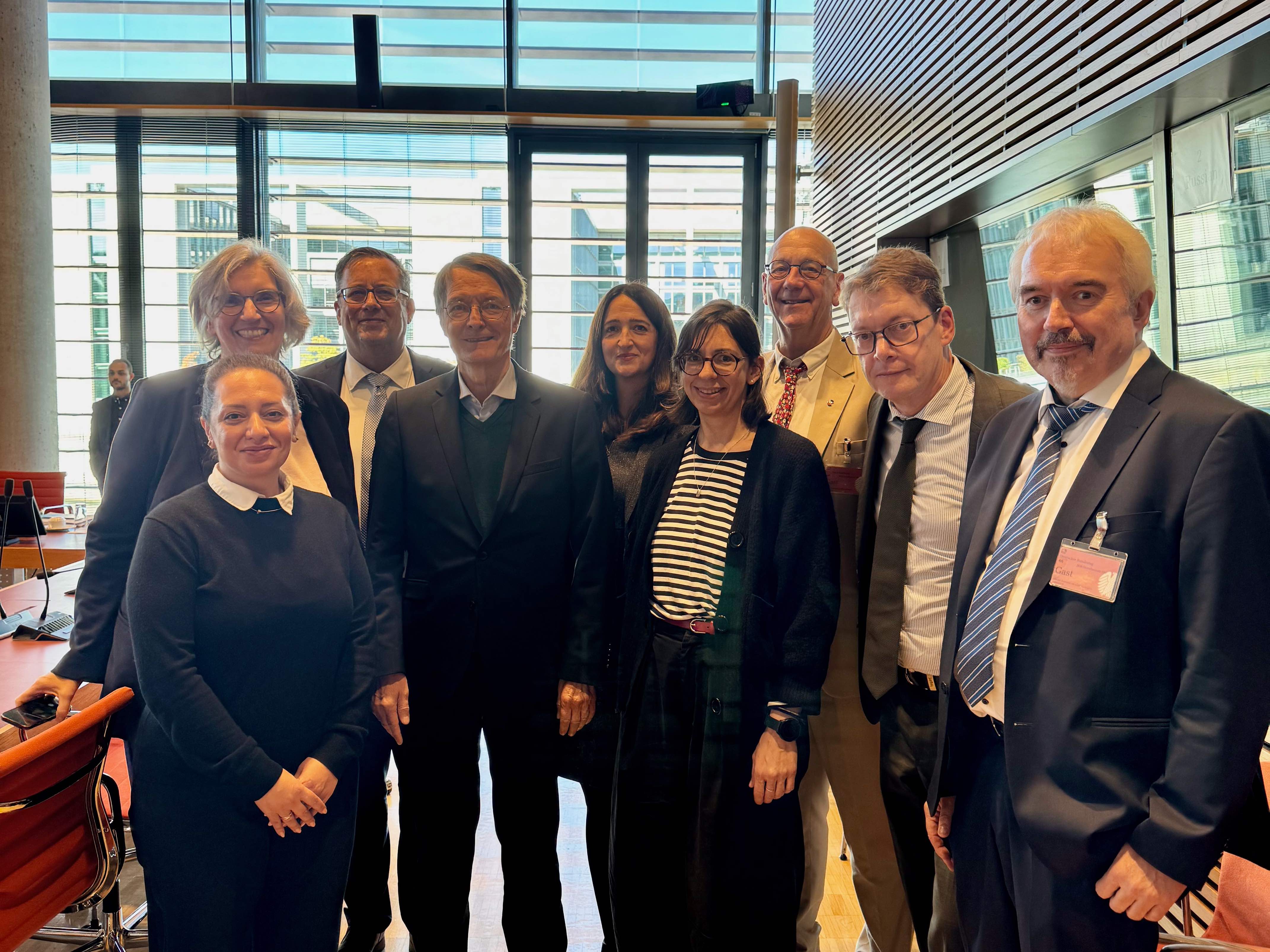 Delegation from the Research Alliance Leibniz INFECTIONS with Prof. Karl Lauterbach
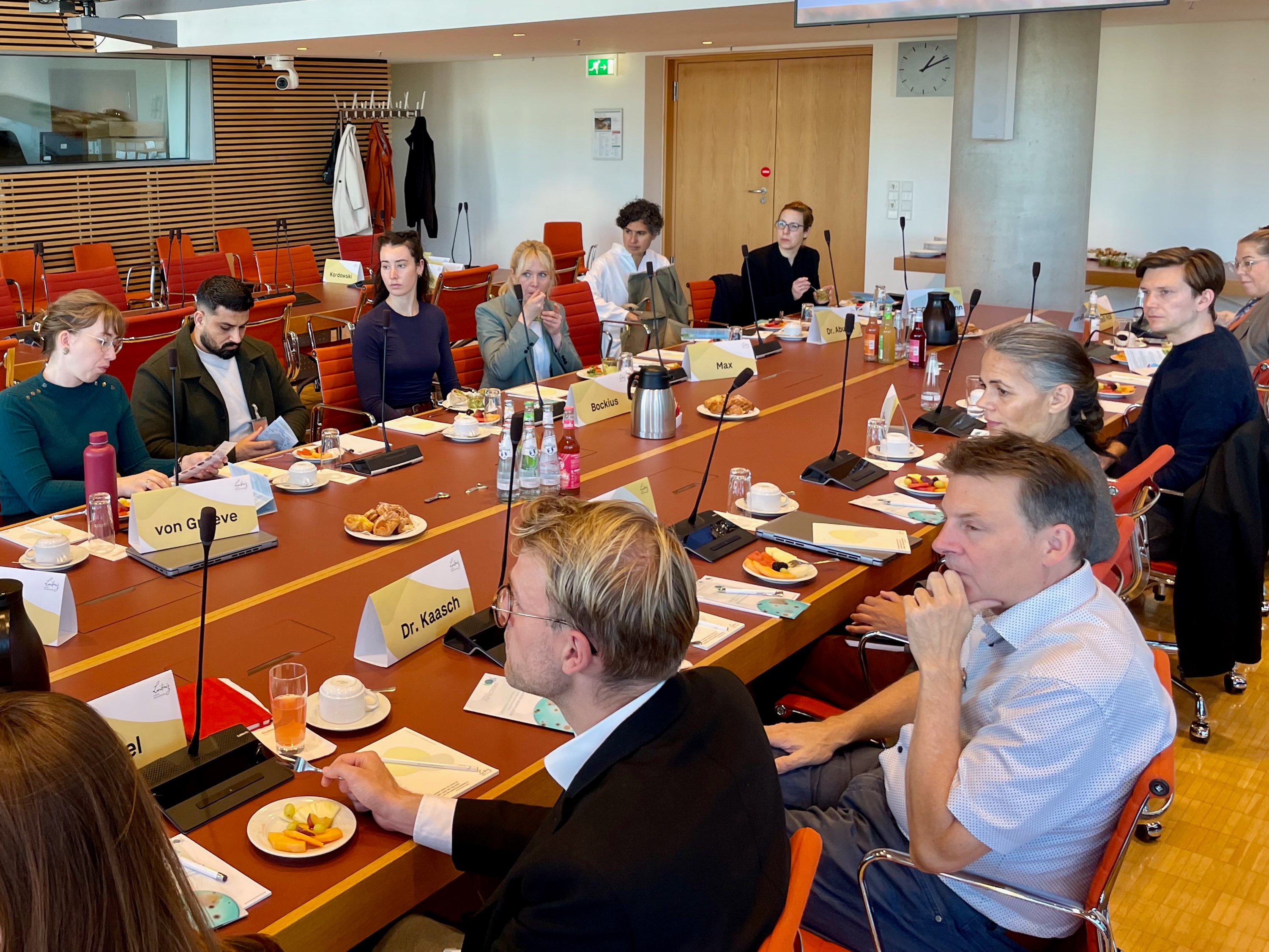 Members of the German Parliament from various parties and their employees attended the Leibniz Lunch to learn different aspects regarding antimicrobial resistance.
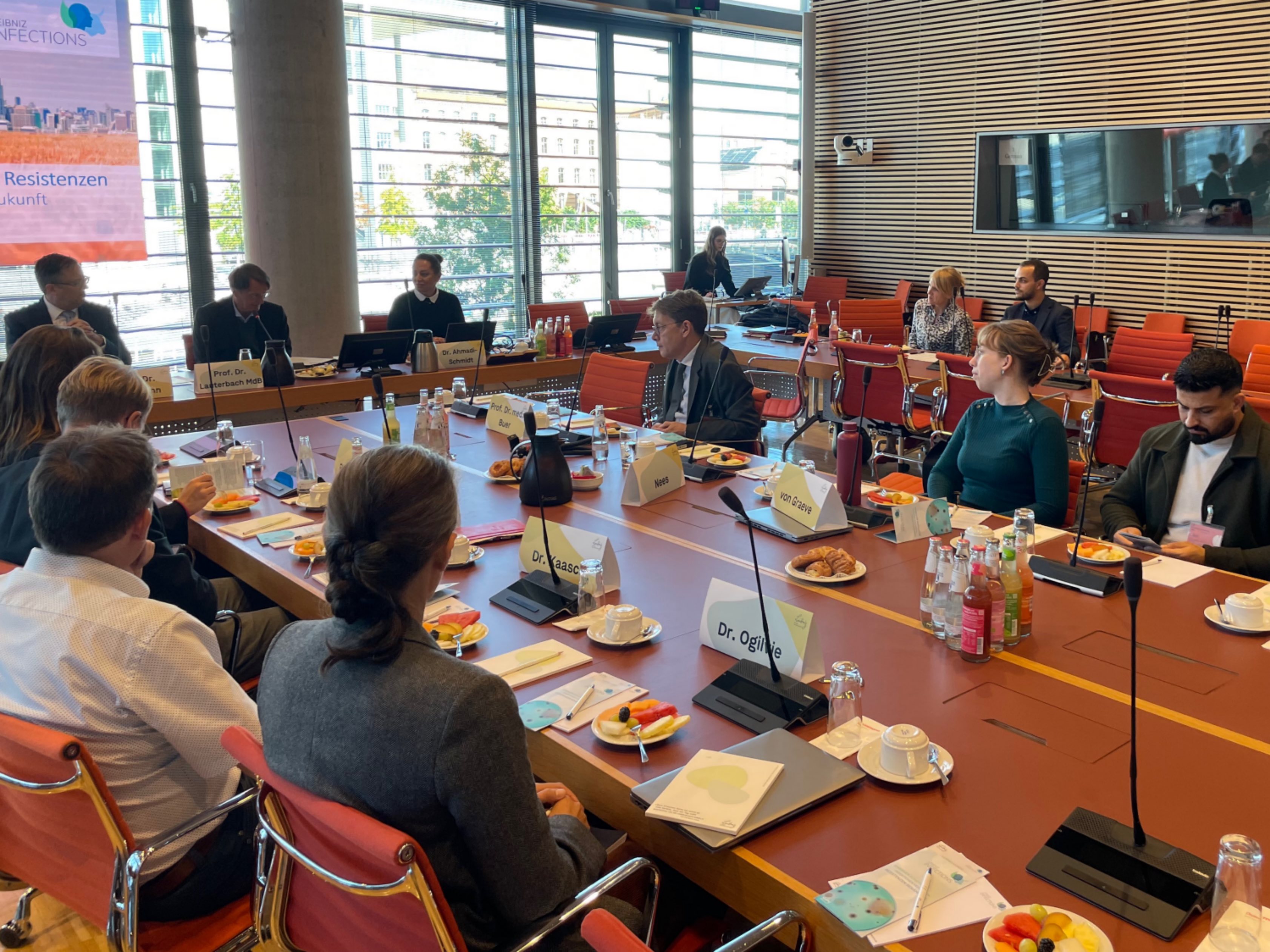 The discussion addressed, among other things, new instruments for research funding and the economic framework for the development of antibiotics.