

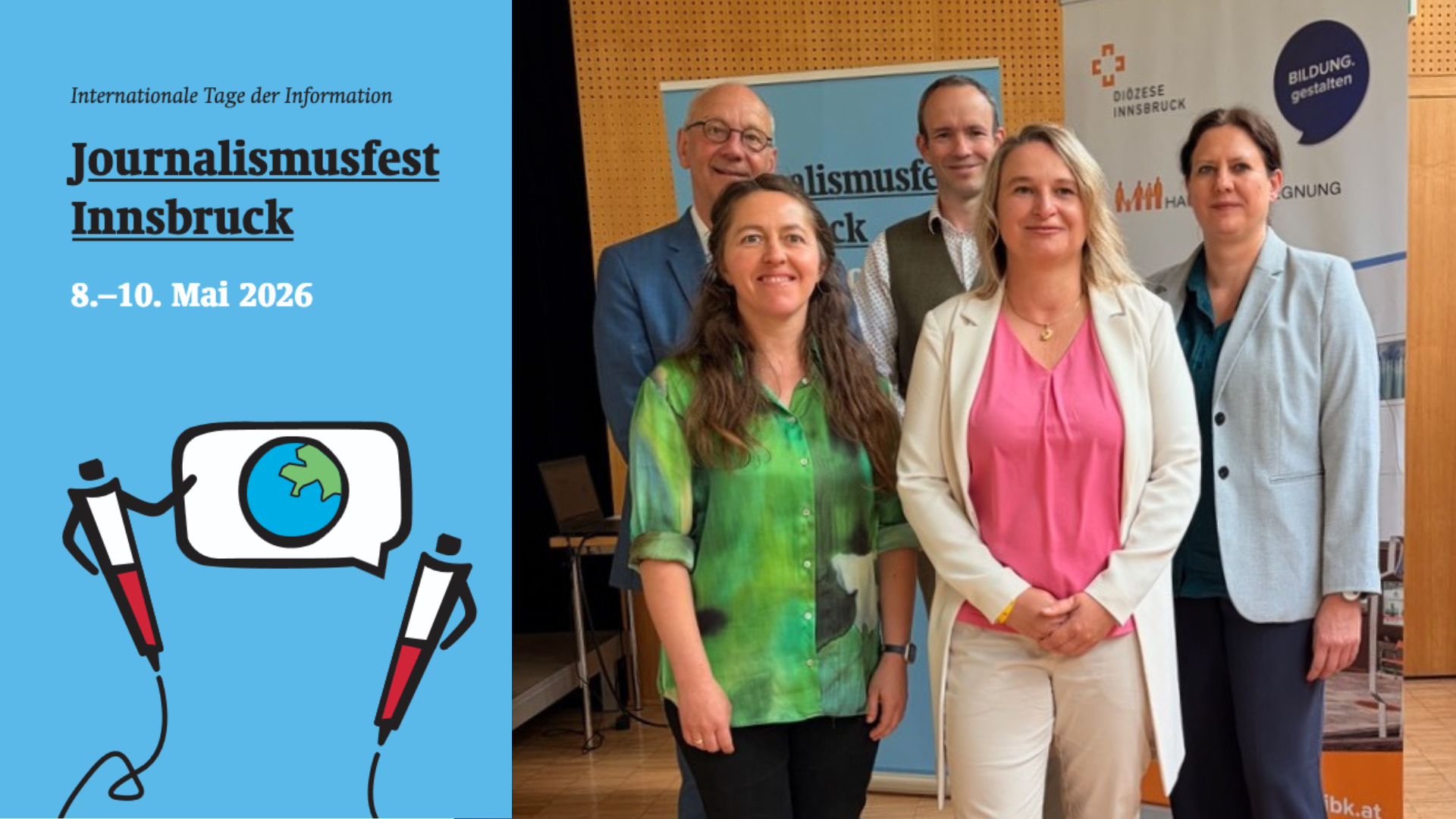
At the Journalismusfest Innsbruck, experts discussed the rising threat of antimicrobial resistance and how to combat it. Prof. Ulrich Schaible from the Research Center Borstel, Leibniz Lung Center, represented the research alliance Leibniz INFECTIONS.
The health of humans, animals, plants, and the environment is closely intertwined and interdependent. The panel discussion “Seeing the Big Picture” at this year’s Journalistenfest Innsbruck therefore explored how health can be approached more holistically in the future. The discussion focused on the global threat posed by antimicrobial resistance (AMR). Many pathogens, including both bacteria and fungi, develop resistance to therapeutic agents. Infections caused by resistant pathogens delay recovery, complicate treatment, and currently result in over 1 million deaths worldwide each year. Projections highlight the urgent need for action. According to these, 10 million people will die annually by 2050 due to infections caused by drug-resistant pathogens, unless effective countermeasures are taken.
Professor Ulrich E. Schaible, an infectious disease biologist at the Research Center Borstel, Leibniz Lung Center, emphasized the urgency of the situation: “The projections for 2050 clearly show that we must act now.” However, he added that human health should not be viewed in isolation. “Resistant microorganisms do not arise and spread solely due to the selective pressure of antimicrobial therapies; they are also linked to human activities. These include impacts on the environment, agricultural practices, public health, and the economic and social conditions under which drugs are developed, sold, and used. The most important factors in the development of resistance are where, how, for what purpose, and in what quantities antimicrobial drugs are used.” To understand why resistance develops and how it spreads, many disciplines must work closely together. This is the approach taken by the research alliance Leibniz INFECTIONS, co-founded by Schaible.
Professor Michaela Lackner from the Institute of Hygiene and Medical Microbiology at the Medical University of Innsbruck drew attention to the often-underestimated danger posed by resistant fungal strains. “Fungal infections and the increasing resistance to corresponding medications have so far received less scientific attention than antibiotic resistance. Yet they are now widespread in both agriculture and human and veterinary medicine.” The goal is to maintain the effectiveness of the few available drugs against severe fungal infections, explained the scientist, who is also a member of the scientific advisory board of Leibniz INFECTIONS.
The discussion also included veterinarian Professor Lorenz Khol from the University of Veterinary Medicine, Vienna, and Professor Sigrid Neuhauser from the University of Innsbruck. The event was moderated by science journalist Tanja Traxler.
About One Health
The One Health approach aims to address health issues from an interdisciplinary perspective. It brings together human and veterinary medicine, environmental research, and other scientific disciplines to identify and mitigate global health risks at an early stage.
About the Innsbruck Journalism Festival
The „Innsbruck Journalism Festival – the International Days of Information“ is a festival open to everyone, featuring journalists from around the world and other knowledgeable communicators of information. It is organized by the non-profit association “Innsbruck Journalism Festival – Association for the Promotion of Quality Journalism, Freedom of Information and Democracy”.