

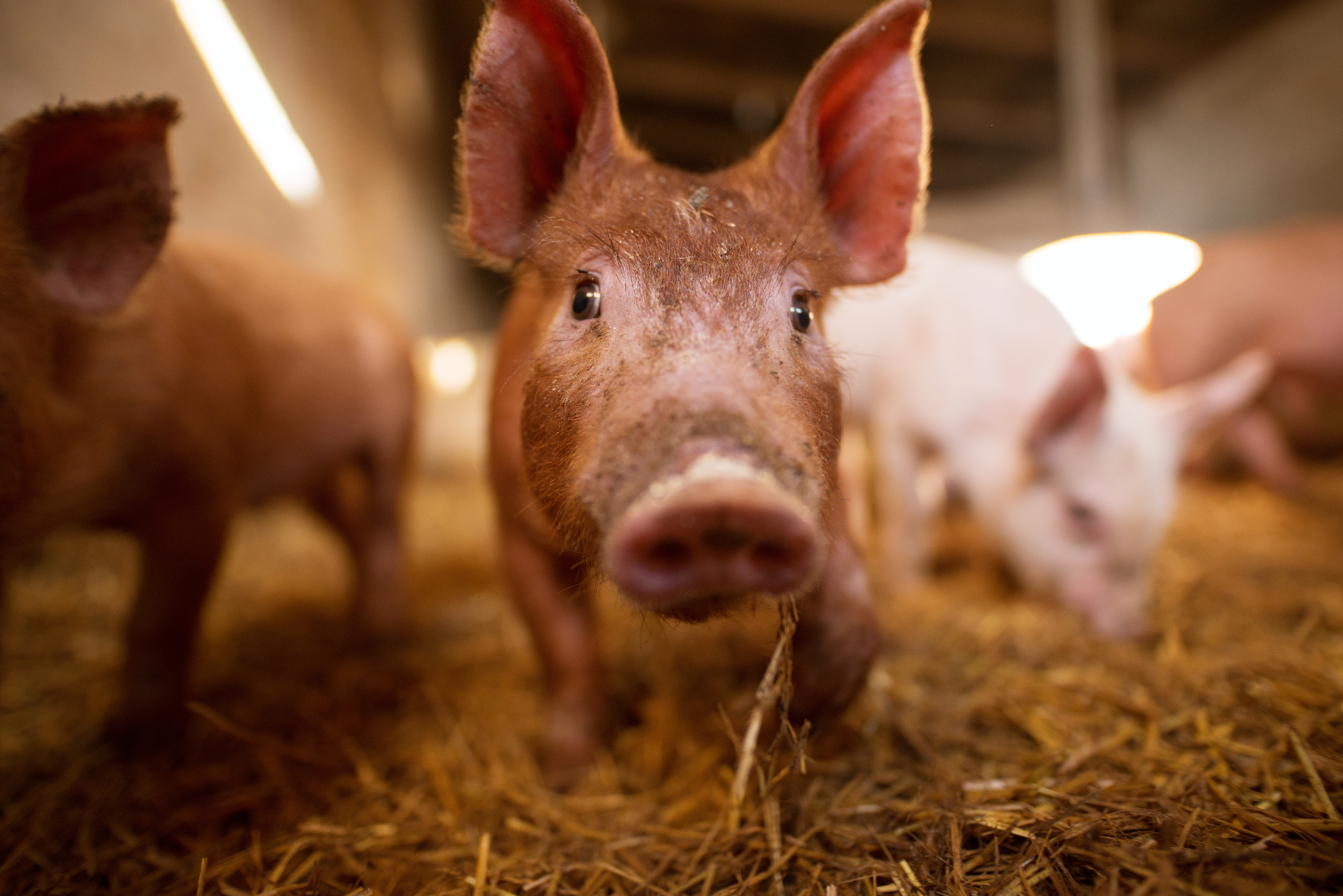
As part of the research alliance Leibniz INFECTIONS, Dr. Megarsa Jaleta conducted research on antibiotic resistance in piglets. In May 2026, he successfully defended his dissertation at the Faculty of Veterinary Medicine at Freie Universität Berlin. The thesis examined how hygiene measures influence the spread of antibiotic-resistant bacteria in pig farming and how the prevalence of resistance genes varies among piglets and chances as they age.
Dr. Jaleta’s research focused on how antimicrobial resistance genes develop in weaned piglets and what role farm hygiene measures play in this process. Antimicrobial resistance occurs when bacteria become resistant to antibiotics. It is considered one of the key challenges facing veterinary and human medicine worldwide. After weaning, so-called weaned piglets are particularly susceptible to infections due to stress and an immature immune system. As a result, weaned piglets receive the highest doses of antibiotics compared to other age groups in pig production. In the context of the One Health approach, understanding the spread of resistance genes in this age group is of central importance for the protection of human and animal health.
The study examined how the frequency and diversity of antibiotic resistance genes (ARGs) in the feces of weaned piglets changed over an eight-week period. The focus was on how much individual animals in a herd differ from one another and whether pooled samples from the pen provide a representative picture of individual contamination levels. He found that the amount of antibiotic resistance genes in the intestines of weaned piglets varies greatly between individual animals, even under identical housing conditions. Furthermore, the total prevalence of these genes in a group cannot be predicted solely by sampling individual animals, as pooled samples from the pen floor exhibit significantly higher levels of resistance. The results of his work were published in the journals Frontiers in Veterinary Science and Frontiers in Microbiology.
Hygiene Measures and Resistance Genes
Resistance genes to widely used antibiotics such as tetracyclines and macrolides were particularly common. Surprisingly, short-term antibiotic treatments of individual sick animals played a minor role in gene dynamics; rather, the animals’ age and changes in their diet shaped the microbial profile. Composite samples collected from the barn floor showed significantly higher levels of resistance than fresh feces from individual animals. This suggests that the genes accumulate in the barn environment or persist there more stably.
The study, titled “Surveillance of antimicrobial resistance in weaner pigs: Impacts of hygiene interventions and resistance gene dynamics,” was conducted in the research group “Infections and Antimicrobial Resistance in Farm Animals” (led by Dr. Tina Kabelitz) at the Leibniz Institute for Agricultural Engineering and Bioeconomy (ATB) and the “Microbial Genomics” department (led by Prof. Ulrich Nübel) at the Leibniz Institute DSMZ-German Collection of Microorganisms and Cell Cultures GmbH (DSMZ). Other collaborating partners included: the Leibniz Centre for Agricultural Landscape Research, ZALF, (Dr. Doreen Werner), the Leibniz Institute for Photonic Technologies, IPHT, (Dr. Anja Silge), and Kiel University (Prof. Dr. Christina Hölzel).
“Our data clearly show that no two weaned piglets are alike in terms of antibiotic resistance. Understanding this individual variability is key to developing more targeted measures against the spread of resistance in livestock farming,” emphasizes Dr. Megarsa Jaleta. “For reliable monitoring in livestock farming, it is therefore not enough to test individual animals alone. We must take into account the entire barn environment and age-related factors in order to effectively minimize the spread of resistance,” adds Dr. Tina Kabelitz, Dr. Jaleta’s scientific supervisor at the ATB.
Dr. Jaletas conclusion: “Improving hygiene in pig barn is important and can reduce infection pressure, but on its own it often achieves inconsistent reductions in AMR. Sustained progress against AMR requires comprehensive management strategy that addresses multiple sources and environmental pathways of AMR spread including but not limited to hygiene.”
Sources:
Jaleta M et al. (2024). Improvements of weaned pigs barn hygiene to reduce the spread of antimicrobial resistance. Frontiers in Microbiology, 15, 1393923. https://doi.org/10.3389/fmicb.2024.1393923
Jaleta, M. et al. (2026): Antimicrobial resistance genes in weaned pigs: quantitative abundance and group dynamics assessed by qPCR. Frontiers in Veterinary Science 12:1709227. https://doi.org/10.3389/fvets.2025.1709227
Contact
Dr. Megarsa Jaleta
Leibniz Institute for Agricultural Engineering and Bioeconomy (ATB)
E-Mail:
Dr. Tina Kabelitz
Leibniz Institute for Agricultural Engineering and Bioeconomy (ATB)
Head of working group "Infections and AMR in livestock"
E-Mail:
Prof. Dr. Ulrich Nübel
Leibniz Institute DSMZ - German Collection of Microorganisms and Cell Cultures GmbH
Head of Microbial Genome Research unit
E-Mail:
 As part of the research alliance Leibniz INFECTIONS, Dr. Megarsa Jaleta conducted research on antibiotic resistance in piglets. In May 2026, he successfully defended his dissertation at the Faculty of Veterinary Medicine at Freie Universität Berlin. ©Kerstin Pukall